Isham Hotel
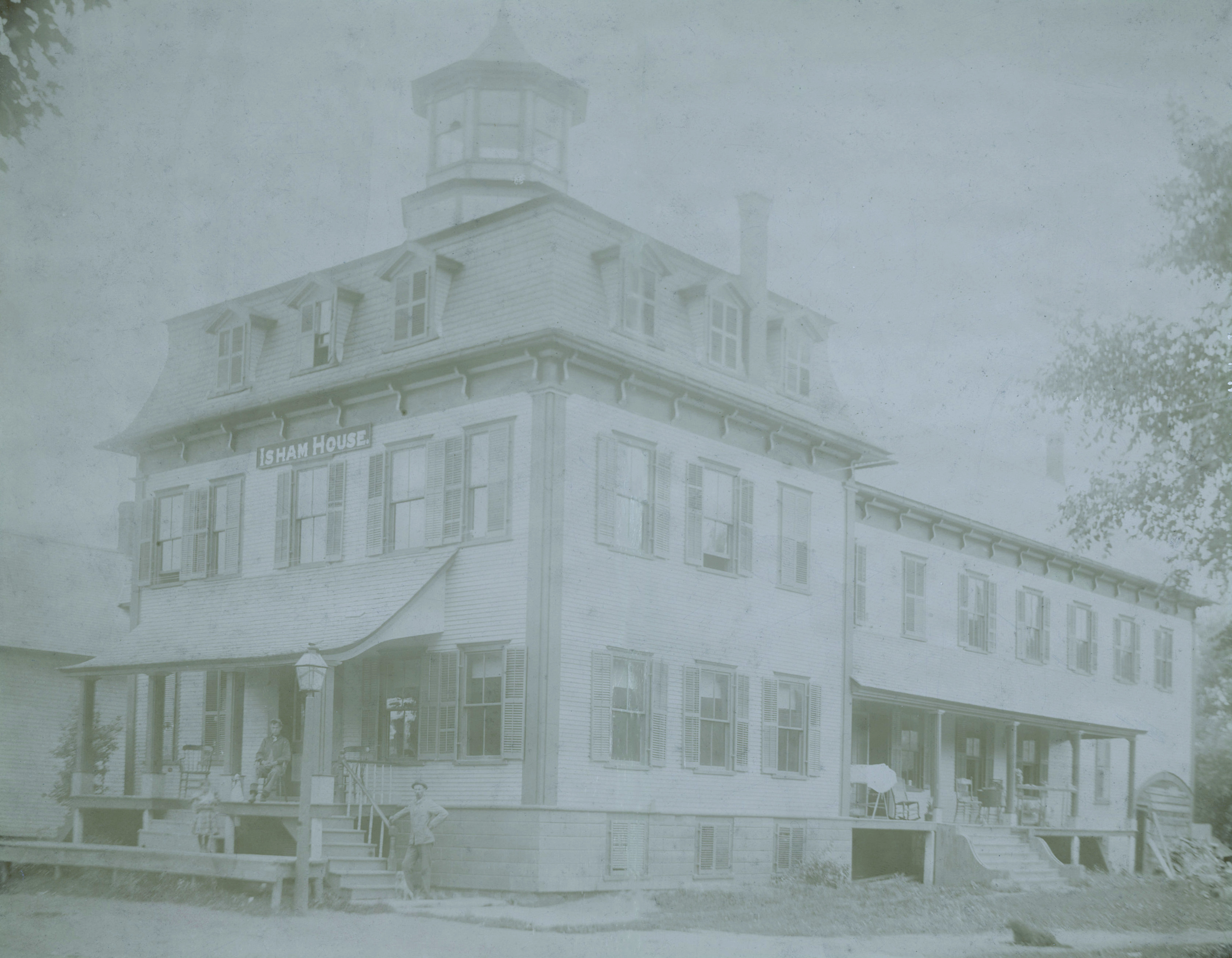
“It was built around 1870 by Henry S. Isham who resided there until his death. When the train came through it stopped at the platform in back of the hotel, giving passengers the choice of either eating dinner, then continuing on their way, or staying overnight for a little dancing on the wonderful spring dance floor which was made of boards put in on edge. When silent movies arrived, they were shown in this hall. Zoa Mitchell played the piano to accompany them. The Isham House also had a livery stable in back. On January 23, 1923 this hotel burned.”
— Fairfield Reminiscences, p. 152
The hotel’s guest register — spanning four volumes and over 18,000 entries from 1881 to 1915 — has been transcribed by the Fairfield Historical Society (with the help of Claude AI) and is fully searchable using the tabs above.
The register recorded not just names but glimpses of lives — traveling showmen, railroad builders, medicine hawkers, minstrels, and local performers all passed through its doors between 1881 and 1916. Below are some of the most colorful groups who stayed here, drawn from the 18,000+ entries in the register. Where a register page is linked, you can view the original handwritten entry.
🧪 Medicine Shows & Patent Remedy Companies
Kickapoo Indian Medicine Co. — October 1886 — Vol. 2, Pages 284 & 291
Of all the traveling shows that passed through Fairfield, none carried a more nationally recognized name than the Kickapoo Indian Medicine Company. Page 284 of Volume 2 records fifteen members of their troupe checking in on October 4, 1886, including performers bearing names like White Bear, Chief White Feather, Boy Eagle of the Hill, Moving Sky, Clear Water, and Squaw White Sky — almost certainly stage names adopted for the show. Tom Adams is listed as "Performer and Musical Artist," and Sam Cuchu likewise. H. H. Rella arrived with a horse. Two weeks later, a second group from the same company appears on page 291, including Dr. Oscar Heale and Dr. Harry Rella, listed as "Party No. 26" — suggesting the company ran dozens of simultaneous touring units across New England.
The Kickapoo Indian Medicine Company was one of the most successful patent medicine enterprises in American history, founded in the early 1880s by John E. Healy and Charles "Texas Charlie" Bigelow. Their flagship product, Kickapoo Indian Sagwa, was marketed as an ancient Native remedy made from roots, herbs, and bark — though rivals claimed it was largely stale beer and aloe, with a generous dose of alcohol. The shows combined vaudeville entertainment, faux Native American ceremonies, acrobatics, and a sales pitch from a man posing as a doctor. At their peak the company had as many as 75 shows touring the country simultaneously. Buffalo Bill Cody was paid to endorse Sagwa. The 1906 Pure Food and Drug Act began their decline, and Kickapoo Cough Cure was found to contain far more alcohol than its label admitted.
Oregon Medicine Co., Party No. 21 — January 1895 — Vol. 3, Page 272
On January 28, 1895, eight members of the Oregon Medicine Co. checked in for a two-week stay — an unusually long residency suggesting they planned an extended run at the Opera Hall. Page 272 lists Dr. Harry Kella (Proprietor & Manager), his wife, performers Billy McMack and his wife, Prof. Charles Morgan, Arthur Hazlett, and one entry that stands out: "Baby Bessie our Mascott" — the group's mascot, likely a child, traveling with the show. Prof. Morgan returns alone on page 274 a few days later. The "Party No. 21" designation mirrors the Kickapoo numbering system, suggesting this was another large regional operation running multiple simultaneous units.
Norman's Dental Company — October 1884 — Vol. 2, Page 101
Eight people arrived together under the name Norman's Dental Company on October 28, 1884. Page 101 lists Hal Clarendon Smith (noted as "from England"), Master Francis Smith, Mr. Charles Oliver, Miss Kate Gowan, Miss Cora Hull, Ingham Northrop, and Miss Sarah Northrop. A note suggests a performance that evening ("Tonight Oliver"). Traveling dental companies were a real phenomenon of the era — itinerant dentists who combined tooth extraction with entertainment to draw crowds, sometimes operating under theatrical names to attract business.
Glens Falls Tobacco Remedy Co. & Billings Horse Remedy Co.
The register preserves two solitary salesmen of more modest remedies. W. L. Billings of Rutland checked in on August 6, 1892 (Vol. 3, p. 75) with two horses and an advertisement affixed directly to the register page — an early form of in-room advertising. O. R. Taylor of Swanton arrived June 28, 1895 representing the Glens Falls Tobacco Remedy Co. (Vol. 3, p. 315), one of many companies that promised to cure the tobacco habit — a popular cure-all category of the 1890s.
Brown's Bronchial Troches
Tucked into the pages of the guest register is a small printed advertisement for Brown's Bronchial Troches, a throat lozenge that claimed to cure coughs, colds, hoarseness, and sore throat. Such advertisements were sometimes left by traveling salesmen or slipped between register pages by guests. The ad is a vivid reminder of the era's patent medicine culture — when printed promises of relief were cheap to produce and widely trusted by a public without access to modern medicine. View the original advertisement.
Cross Cut Cigarettes Advertisement
Another item found among the register pages is a colorful advertisement poster for Cross Cut Cigarettes, bearing what appears to be the name W. Dukehouse Co. in cursive lettering. Cigarette advertising was ubiquitous in the 1880s and 1890s, and traveling salesmen routinely carried promotional materials. That this poster ended up tucked into the Isham guest register suggests a salesman may have left it behind — or perhaps Henry Isham himself simply found it a convenient place to store it. View the original advertisement.
🎭 Theatrical Troupes & Dramatic Companies
Flora Myers Dramatic Company — October 1881 — Vol. 1, Pages 20–21
Among the very first theatrical visitors to the register, the Flora Myers Dramatic Company arrived in October 1881 to perform Uncle Tom's Cabin, one of the most popular touring productions of the 19th century. Page 21 lists ten members including Flora Myers Purcell (the company's namesake and likely lead actress), her husband A. F. Purcell, Henry Haford, Athol Malcolmn, M. E. Casey, C. F. Bryant, O. H. Vaughan, and entries for "Children," "Emma," and "Pearl" — suggesting a family-friendly full-cast production. An advance man, A. Wentworth, had checked in a few days earlier on page 20 to arrange accommodations.
Uncle Tom's Cabin adaptations dominated rural American theater in this era. By the 1880s, dozens of competing troupes — called "Tom shows" — crisscrossed the country, ranging from lavish productions with live animals to modest one-night stands in country hotels. That this was among the Isham Hotel's earliest theatrical guests speaks to Fairfield's place on the touring circuit from the very opening of the register.
Seymour, Stratton Combination — February 1883 — Vol. 1, Page 191
A lively ten-member troupe filled page 191 on February 2, 1883. Led by Thomas Stratton and featuring Miss Lizzie Seymour Stratton as likely the female lead, the company also included Baby Bell, Miss Gertrude Bell, Miss May Mack, Alf P. Stockman, Ed Conner (whose room note reads "Hard Times of 1883" — possibly the name of the play), Charles McWilliams, L. J. Thomas, and Fred P. Wilson. The room assignments are carefully noted — Rooms 10, 10.5, 11, 11, 11.5 — filling the upper floor of the hotel.
Walter Keyes Cosmopolitan Show — September 1883 — Vol. 1, Page 201
Eighteen performers arrived together on September 26, 1883 — the largest single theatrical party in the entire register. Page 201 lists G. E. Witherell and Jennie Witherell in Room 11 (with a note: "Next stand: Enosburg Falls," confirming the troupe's touring route), Benjamin Belmont, E. J. Darcy, Thomas O'Hare, Annie and Charles Austin, Thomas Wooster, and a dozen more, distributed across nearly every room in the hotel. The Cosmopolitan Show name suggests a variety-format entertainment popular in the 1880s — a precursor to vaudeville.
Cooney's Dramatic Co. — June 1894 — Vol. 3, Page 209
Thomas J. Cooney and his wife led a dramatic company that performed at Croft's Opera Hall for three nights, June 25–27, 1894. Page 209 lists the full company including Jennie Ashley, Lena W. Cole, Mabel P. Kealer, O. C. Penman, and Lawrence Poole, with two overlapping company names on the same page — suggesting Cooney ran a combined operation. Croft's Opera Hall appears repeatedly in the register as the local performance venue, and was clearly a significant cultural institution in Fairfield in the 1890s.
Rockwell's Peoples Theatre Co. — February 1894 — Vol. 3, Page 181
Nine members of this company arrived on February 18, 1894, led by Mrs. J. C. Rockwell — listed as "Prop and Manager," a notable designation for a woman running a theatrical company in the 1890s. Page 181 includes Miss Rose Bernard, Miss Clara Davenport, Miss Georgie Helwig Russell, Charles N. Russell, Edwin O. Brown, Eugene Bryant, Ed Keane, and Thomas O. Stanway, each carefully assigned to rooms 8 through 11.
Excelsior Comedy Co. — November 1894 — Vol. 3, Page 251
Nine performers arrived November 12, 1894. Page 251 offers some vivid incidental detail: Miss Arline Ross asked that her mail be forwarded to the Crawford House, and spent 10 cents on a cigar. Mrs. Howard Clifton, Miss Minnie Thane, Miss Emma Thewell, Mr. & Mrs. W. M. Paul, F. A. Pyne (with wife), and manager Frank L. Juance completed the party.
Russell-Patton's Comedians — June 1895 — Vol. 3, Page 309
Seven performers arrived June 6, 1895 for a three-night engagement at the Opera House. Page 309 gives ticket prices — 15, 25, and 35 cents — and lists manager L. J. Russell, his partner W. B. Patton, and performers Miss Ida H. Campbell, Frank Sheldon, Miss Dorothea Velbert, Harry Ward, and E. L. Newton. The careful notation of room assignments and departure times ("Time: D") reflects the hotel's practiced efficiency with theatrical parties.
Later Troupes: Into the 20th Century
Theatrical visitors continued well into the register's final decades. The Royal Hall Comedy Co., featuring Eddie and Lenora Erickson alongside Walter and Mrs. W. H. Chapin, appears twice — in November 1910 (Vol. 4, p. 73) and again in August 1911 (p. 103), suggesting they found the Isham a reliable stop on their circuit. The Ministers Sweetheart Co. passed through in April 1913 (Vol. 4, p. 179). Most striking is the agent for Girls of the Streets — F. M. Shorkey — who checked in February 10, 1914 (Vol. 4, p. 216) to announce the show was coming "Wed. Feb. 18." The title, shocking to modern ears, was a common melodrama genre of the era.
🎶 Minstrel Shows
Lucier's Minstrels — July 1894 — Vol. 3, Pages 214 & 216
The advance agent A. M. Griswold arrived July 12, 1894 (page 214) to book Lucier's Minstrels at Croft's Opera House for Wednesday, July 18th. Six days later, seventeen members of the company checked in, filling page 216 with a roster that reads like a playbill: Prof. J. R. Lucier (whose room note reads "Croft's Opera Hall Tonight"), Mlle. Marguerite Lucier, C. N. Lucier, Dr. George Huntley (Manager), Billy Freeze ("Call Comp 7"), La Freeze, Fred W. Kenno, Fred T. Palmer, C. A. Perry, C. E. Potter, Herman Pruefer, and C. N. Thomas.
Minstrel shows were among the most popular entertainment forms in rural America from the 1840s through the early 20th century. The "Professor" and "Mademoiselle" designations, along with the family surname shared by several performers, suggest this was a family-run operation with a polished variety format.
Comical Brown's Oddities — November 1881 — Vol. 1, Pages 33 & 36
One of the earliest entertainment groups in the register, agent H. W. Lavender arrived November 19, 1881 (page 33) with a note advertising an "Entertainment at E. Fairfield Union Church Sat. Eve. Nov. 19th 1881" — the same night he checked in. The company itself appears on page 36: William B. Brown, Miss Alice De Vere, Miss Ida De Vere, and E. H. Marble, all from Boston. Another agent, H. W. Murm, represented a related act called "Dan Ducelle Shaw." The performance at the Union Church, rather than a hotel hall, shows how traveling shows relied on whatever local venues were available.
🎺 Musicians, Bands & Specialty Acts
Shaffer's Novelty Concert Company — Swiss Bell Players
Among the most distinctive acts to visit the Isham Hotel, Shaffer's Novelty Concert Company brought their Swiss Bell Players to Fairfield — a traveling ensemble performing on a set of tuned handbells in the European tradition. Handbell ensembles were a popular novelty act in late 19th century America, drawing audiences who had never seen or heard the instrument played in concert. A four-page promotional flyer for the company was preserved with the register materials and gives a vivid picture of how traveling acts marketed themselves to rural communities. View flyer page 1 • Page 2 • Page 3 • Page 4
Rounds Band — September 1892 — Vol. 3, Page 87
On September 1, 1892, eleven musicians checked in together, each arriving on horseback. Page 87 lists their instruments in careful detail: George L. Rounds (Solo Banjo), W. G. Jarrett (1st Banjo), Wesley Gray (2nd Banjo), Herbert Williams (3rd Banjo), Fred Eldred (1st Alto), Fred Spicer (2nd Alto), H. W. Webster (Baritone), Carl Shull (Trombone), M. L. Hubbell (Eb Bass), W. R. Ouitt (Bass Drum), and H. J. Isham (Snare Drum) — the last sharing the hotel family's name. The emphasis on multiple banjos alongside brass instruments reflects the quintessential sound of rural American dance music in the 1890s.
Shepard Family Musical Entertainment — March 1886 — Vol. 2, Page 222
Advance agent S. W. Raymore arrived February 25, 1886 to prepare the way, and on March 4 the Shepard family themselves checked in: Mr. J. M. Shepard, Mrs. W. E. Shepard, Miss Kittle Shepard, Lucie Shepard, Georgia Shepard, and Miss L. Bella Shepard. Page 222 notes that Bella Shepard's room note reads "Soule's Hall tonight." Family musical acts were a staple of the New England touring circuit — intimate, wholesome entertainment that played well in small communities.
Parker's Orchestra — Thanksgiving 1894 — Vol. 3, Page 256
Eight musicians arrived on Thanksgiving Day, November 29, 1894. Page 256 is notable for what the transcriber noted as an "elaborate orchestra illustration in the register" drawn by the guests themselves. The party included manager A. A. Claflin, musical director B. Kelly, treasurer William LeCou, and players E. Blondui, H. L. Chadwick, J. H. Park, L. A. Ryan (all from St. Albans), and Miss Mable Rane from Prescott, Ontario. The mix of Vermont locals and a Canadian player suggests a regional ensemble rather than a touring company.
Dayton's All Feature Show — December 1891 — Vol. 3, Page 39
Agent C. Hood checked in December 9, 1891 to book Prof. W. W. Dayton's show at Isham's Hall for December 16–17. Page 39 lists the company: the Professor himself (from New York), Jud Sato ("Juggler"), Harry Woodward, and the Blodgett brothers. The juggler Jud Sato — Japanese-sounding stage name notwithstanding — represents the vaudeville specialty acts that were beginning to replace older minstrel formats by the 1890s.
Andrus & Dionne's Wonderland — October 1892 — Vol. 3, Page 96
Two men checked in on October 14, 1892 for a magic show at Isham House that same evening: J. H. Andrus (Artist) and H. E. Dionne (Magician). Page 96 is one of the most compact entries in the register — just two men, two rooms, one night — but the act name "Wonderland" places it squarely in the tradition of conjuring and illusion entertainment that was enormously popular before motion pictures arrived.
Wild Train Troupe — January 1884 — Vol. 1, Page 209
One of the most unusual entries: five men checked in January 3, 1884 with railroad job titles written in place of first names — James Era, Engineer; Fred Kelley, Pilot; J. R. Lawrence, Fireman; Charles White, Brakeman; and Charles Hutton, Com[edy?]. Page 209 leaves their purpose tantalizingly ambiguous — were these actual railroad workers, or performers in a railway-themed theatrical act? Given the "Wild Train" name and the theatrical context of other register entries, a comedy act built around railroad life seems likely.
🚂 Railroad Men
The Isham Hotel's location in Fairfield placed it at the intersection of two significant Vermont railroads, and their workers became some of the hotel's most regular guests.
Burlington & Lamoille Railroad — 1885–1886 — Vol. 2, Pages 181, 182, 211, 303
Thirty-six entries across multiple visits document workers from the Burlington & Lamoille Railroad, with the heaviest concentrations in September 1885 and November 1886. Pages 181 and 182 show a core team — Thomas Leonard, C. E. Severance, H. H. Smith, and E. D. Levick — checking in and out over several consecutive days in September 1885, consistent with survey or maintenance work on a specific section of track. By November 1886, page 303 records a remarkable group of twenty workers arriving together in a single day, including J. Martin Isham — sharing the hotel family name.
The Burlington & Lamoille Railroad was chartered in 1875 and completed in 1877, running from Burlington to Cambridge Junction where it connected to the Lamoille Valley line. The men recorded in the Isham register were likely Central Vermont employees engaged in maintenance or construction work on this branch through Fairfield.
St. Johnsbury & Lake Champlain Railroad — 1882–1885 — Vol. 1 & 2
Nineteen entries document workers from the St. Johnsbury & Lake Champlain Railroad, spanning 1882 to 1885. Repeat visitors include E. C. Boomhower, D. W. Leonard, C. W. Hawkins, J. M. Manning, and Frank Spaulding. Vol. 1, page 128 shows entries with dollar amounts noted — $20 and $1.50 — possibly board bills or per diem expenses. Known as "The Bridge Road" for its six covered railroad bridges, the line passed directly through Fairfield, making the Isham a natural lodging for the railroad's crews.
🌟 Local Dramatic Clubs
Emerald Dramatic Club — May 1894 — Vol. 3, Pages 192–193
The largest local group in the register: twenty-four members of the Emerald Dramatic Club from St. Albans filled pages 192 and 193 on May 1, 1894. The predominantly Irish surnames — Clancey, Connors, Duffy, Kernan, McGrath, Murphy, Mulchay, Sullivan — reflect St. Albans' large Irish Catholic community, which had grown substantially from railroad and textile workers who arrived in the mid-19th century. The group included a "Hon. Frank Garland" and W. Richie (Treasurer). One guest came from Ogdensburg, NY, suggesting the club had connections across the border. The Emerald name was a common choice for Irish-American social and theatrical organizations throughout New England in this period.
East Fairfield Dramatic Club — January 1895 — Vol. 3, Page 271
Eleven members of the local East Fairfield Dramatic Club checked in January 25, 1895 to perform with Crawford's Dramatic Company at the Opera Hall. Page 271 lists H. E. Croft (who may have been connected to Croft's Opera Hall, the main venue in town), J. Grant Gilbert, John S. Burleson, J. G. Burnham, Daniel Knack, H. H. Money Jr., H. A. Doanes, and several women — Miss Burleson, Miss Gilbert, and Miss Merrill. Their proximity suggests these were Fairfield community members who needed lodging for only one night, perhaps because the performance ran late or they lived at a distance in town.
This is only a sample of the remarkable groups documented in the Isham Hotel register. The Search tab allows you to explore all 18,000+ entries by state, city, year, and surname — including the full records for every group mentioned above.